Showing posts with label NIweek. Show all posts

Thursday, August 4, 2011

Chasing tornadoes

This is my last post live from NIWeek 2011, my plane leaves in a few hours and the show is finished now anyway. Looking back I had a good show with many interesting and exciting! encounters, technical as well as human. Look, I even made a friend.


He is great because he plays soccer and he is as good at it as I am. I bet he dances like me too.

Today was the last keynote during which several impressive student projects were presented including the world-wide winning (www) project in the student project competition. This was a 3D display that you can actually build at home thanks to its extraordinary simplicity.


The keynote ended with a presentation by Tim Samaras who chases tornadoes for a living. Tim showed some very spectacular footage of tornadoes but also of lightning, because that is his second hobby. He and his team film lightning with very high-speed cameras so that you can actually see how the lightning makes its way down to earth. Wow.

With a bit of luck I will be back here in Austin, Texas next year. If so, maybe see you then or there!

Wednesday, August 3, 2011

25 years of LabVIEW

The second day of NIWeek started with the second keynote presentation. Jeff Kodosky, the father of LabVIEW, opened the session during which he looked back on 25 years of LabVIEW.

Jeff K was followed by the part that I like most of the NI events: the user applications. Often a few interesting and sometimes quite spectacular real-life applications of NI equipment are presented and demonstrated. This year were on display a portable real-time optical coherence tomography (OCT) device, a structure health monitoring system that is being used for real-time bridge surveillance, the smart grid in Rajasthan, India (did you know that 400 million people in India do not have access to electricity?), a system to control the plasma position in a tokamak (we are talking nuclear fusion here), a couple of robots, an XBox Kinect interface for LabVIEW and a water display that uses water drops as pixels (see photo, can you see "NI" written in droplets?).

The company who made this told me that they have no practical use for such a display.

The keynotes closed with some philosophing about how LabVIEW may evolve during the next 25 years. According to Xilinx, their new Zync platform will play a role here in the near future.

That's all for now folks, I am going to attend a presentation about Arduino, Android & LabVIEW.

P.S. Thanks Greg, I received your text.

Tuesday, August 2, 2011

Geek power

After a long day of presentations, interviews and normal editorial work (if you think I am on holidays, you are mistaken. BTW, Greg, I need your article.) tonight was the night of National Instrument's Graphical System Design Achievement Awards. This is a yearly invitation-only event for which you are supposed to dress up, which I did, sort of. NI offers awards in eight categories for the best applications using NI products. There are, in my opinion, three interesting things about this event.

The first is the presentation with as main attraction Dave Wilson, the companies director of academic and corporate marketing who, in about one hour, manages to use as many words as I use in an average week.

The second thing is the exoticness of the project subjects. From non-invasive cancer diagnostic to bridge structure testing to quantum mechanics, the geekier the better seems to be the devise.

Finally, it is the international character of the project that amazes me. The projects are literally sent in from all over the world and no part of the world seems to be favorized.

The winner of the grand prize, an entry in NI's hall of fame, was this year the paper "FPGA-Based Feedback Control of a Single Atom Trajectory". You can find it on NI's web site.

To improve your chances to win next year make sure to use at least a Kalman filter, a couple of Hall effect sensors and PWM in your system. Dave will love it!

Graphical system design

This morning NIWeek really started with the first keynote introduced, as always, by Dr. T. himself (one of the three cofounders of NI). The keynotes are rather impressive events with an audience of several thousands. It is used to introduce the most important new products for the year to come. Demos have been very carefully prepared and are presented by the people who were actually involved in the development of the product, which I think is good.

I was a bit disappointed by today's keynote. It was less spectacular than last year and I found Dr. T's introduction not very inspired. The main theme to retain is NI's objective to use software to solve problems so that the client can profit from Moore's law. This was illustrated by some demos of very high performance instruments.


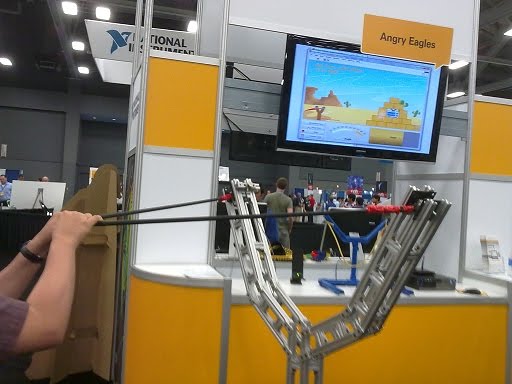
The fun part of the presentation was a variation of the game Angry Birds coded in LabVIEW. In Angry Eagles (as it is called) the player launches the bird with a real catapult instead of a virtual one.


Oh yeah, I almost forgot, LabVIEW 2011 was announced.

Monday, August 1, 2011

Getting ready for tomorrow

OK, the first day of NIWeek, or to be more precise, of pre-NIWeek just came to an end with the Kick-off Happy Hour. Before that I attended the Exclusive Show Floor Preview. This tour took the international press - except for the Chinese/Japanese who had their own group - along the major attractions of mainly NI. Since I was also present at NIWeek 2010, I was able to separate the upgrades and evolutions from the real novelties. Of course, the really spectacular demos will only start tomorrow during the keynotes of the Grand Opening.

I will talk more about interesting applications and products in the days to come when I will have more time to talk to the people presenting them. Yet I would like to mention one of the most impressive things on display: the Hermes Spacecraft. This is a project a guy started alone in his garage, now he is being helped by engineers from Intel who have too much spare time on their hands. The goal is nothing less than commercial space travel!

Check out Sensational Susan online.

USRP update: as it turns out, the USRP-2920 is not 100% identical to the USRP N210, but I did not yet have the opportunity to find out what the differences are exactly.

SDR soon playing at a university near you

Two years ago I assisted at a meeting at Elektor during which Software Defined Radio (SDR), GNU radio and its hardware platform the Universal Software Radio Peripheral (USRP) were discussed. The GNU radio people were really convincing and I liked the concept, but since then I didn't hear much of it. One of the reasons, I thought, was that the USRP (version 2 at the time) was quite an expensive platform.

During the visit of the University of Texas (UT) this morning a wireless class was presented that was based on SDR. The hardware platform was a PXI from National Instruments and the programming was done, of course, in LabVIEW. The goal of the course is to familiarise students with wireless concepts and instead of treating the subject only in a theoretical way, the UT decided to use an SDR hardware platform so that students can easily implement and try out the concepts in the real world. An excellent concept if you ask me.


Instead of keeping it a UT-only course they went a step further and developed an educational package that other schools and universities can buy from the UT. This package includes two now-where-did-I-see-you-before? USRPs (on the left in the photo). Actually, the USRP is now an NI product because NI bought Ettus Research in February 2010. I am afraid this will not really help to lower the price of the USRP.

I don't know if there is a difference between the USRP N210 that you can buy from Ettus and which looks identical to the USRP-2920 from NI, but maybe I can find that out this afternoon during the special USRP session?

In Texas everything is bigger

After having spent the sunday to get used to the what they allready call here the hottest summer ever (over 40 degrees Celsius for more than 50 days) today I will start attending NIWeek 2011. The show opens in less than one hour, but since it is just across the street I just have time to open the blog now.

My day will begin with a visit of the University of Texas (UT), the largest university of the USA as they say here in Austin with some 80,000 students. However, according to the internet, the UT is only the fifth university of the USA with just over 50,000 students. "In Texas everything is bigger" is another thing they like to say here. Apparently this holds true for claims too.


Stay tuned as there will be more to come.