This morning NIWeek really started with the first keynote introduced, as always, by Dr. T. himself (one of the three cofounders of NI). The keynotes are rather impressive events with an audience of several thousands. It is used to introduce the most important new products for the year to come. Demos have been very carefully prepared and are presented by the people who were actually involved in the development of the product, which I think is good.
I was a bit disappointed by today's keynote. It was less spectacular than last year and I found Dr. T's introduction not very inspired. The main theme to retain is NI's objective to use software to solve problems so that the client can profit from Moore's law. This was illustrated by some demos of very high performance instruments.
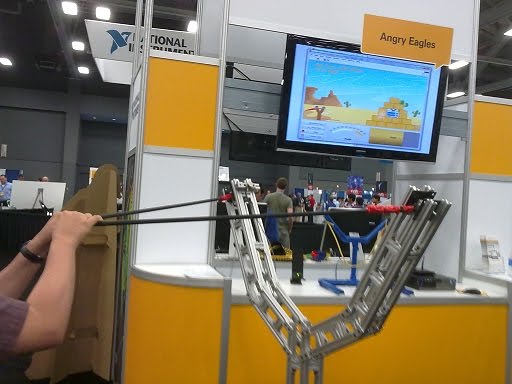
The fun part of the presentation was a variation of the game Angry Birds coded in LabVIEW. In Angry Eagles (as it is called) the player launches the bird with a real catapult instead of a virtual one.
Oh yeah, I almost forgot, LabVIEW 2011 was announced.
OK, the first day of NIWeek, or to be more precise, of pre-NIWeek just came to an end with the Kick-off Happy Hour. Before that I attended the Exclusive Show Floor Preview. This tour took the international press - except for the Chinese/Japanese who had their own group - along the major attractions of mainly NI. Since I was also present at NIWeek 2010, I was able to separate the upgrades and evolutions from the real novelties. Of course, the really spectacular demos will only start tomorrow during the keynotes of the Grand Opening.
I will talk more about interesting applications and products in the days to come when I will have more time to talk to the people presenting them. Yet I would like to mention one of the most impressive things on display: the Hermes Spacecraft. This is a project a guy started alone in his garage, now he is being helped by engineers from Intel who have too much spare time on their hands. The goal is nothing less than commercial space travel!
USRP update: as it turns out, the USRP-2920 is not 100% identical to the USRP N210, but I did not yet have the opportunity to find out what the differences are exactly.
Two years ago I assisted at a meeting at Elektor during which Software Defined Radio (SDR), GNU radio and its hardware platform the Universal Software Radio Peripheral (USRP) were discussed. The GNU radio people were really convincing and I liked the concept, but since then I didn't hear much of it. One of the reasons, I thought, was that the USRP (version 2 at the time) was quite an expensive platform.
During the visit of the University of Texas (UT) this morning a wireless class was presented that was based on SDR. The hardware platform was a PXI from National Instruments and the programming was done, of course, in LabVIEW. The goal of the course is to familiarise students with wireless concepts and instead of treating the subject only in a theoretical way, the UT decided to use an SDR hardware platform so that students can easily implement and try out the concepts in the real world. An excellent concept if you ask me.
Instead of keeping it a UT-only course they went a step further and developed an educational package that other schools and universities can buy from the UT. This package includes two now-where-did-I-see-you-before? USRPs (on the left in the photo). Actually, the USRP is now an NI product because NI bought Ettus Research in February 2010. I am afraid this will not really help to lower the price of the USRP.
I don't know if there is a difference between the USRP N210 that you can buy from Ettus and which looks identical to the USRP-2920 from NI, but maybe I can find that out this afternoon during the special USRP session?
After having spent the sunday to get used to the what they allready call here the hottest summer ever (over 40 degrees Celsius for more than 50 days) today I will start attending NIWeek 2011. The show opens in less than one hour, but since it is just across the street I just have time to open the blog now.
My day will begin with a visit of the University of Texas (UT), the largest university of the USA as they say here in Austin with some 80,000 students. However, according to the internet, the UT is only the fifth university of the USA with just over 50,000 students. "In Texas everything is bigger" is another thing they like to say here. Apparently this holds true for claims too.
This morning (29/7) I took off from Schiphol (Amsterdam airport) for Austin, Texas to assist at the 17th NIWeek. During the flight I kept my phone switched off in a pocket of my pants. Now, when my phone is switched off the key lock function does not work because it is a function of the operating system of the phone, not a hardware feature. So, without me noticing, my phone got switched on in my pocket while I was looking out of the window (I had a window seat) and apparently I unknowingly sort of "punched" in (with my thigh or handkerchief) several wrong PIN codes which resulted in a blocked SIM card when I took my phone out again in Houston (where I had to change planes). To unblock the PIN code my phone now first wanted a Personal Unblocking Code (PUK) code, which off course I didn't know. A helpful girl in a phone shop on the airport told me that this code is often printed on the SIM card itself. So I examined my SIM card and indeed discovered a 17-digit code of which the first 8 digits turned out to be the PUK code for my SIM card. Great!
Or is it? Thanks to the missing hardware key lock feature my SIM card got blocked, but thanks to the PUK code conveniently printed on my SIM card, I can unblock it again. And if I can do this, anyone who gets hold of my phone can do this. How's that for anti-theft protection?
So, problem solved? Well... no. Entering the PUK code gave me the right to choose a new PIN code that I had to confirm by typing it again, which I did without errors. 1234 is not so difficult to get right, right? Wrong! According to my phone my new PIN code is incorrect (???) and I am back to the PUK code. I would now be stuck in an endless loop if it weren't for the cleverly built-in hang protection (they did think of that): the number of tries is limited to 8. I still have 3 left...
Have you ever heard of the company Valens Semiconductor? I hadn't either, until last night.
In 2009 Valens Semiconductor together with LG, Samsung and Sony announced their intention to launch a cross-industry alliance to promote and standardize the HDBaseT technology for whole-home distribution of uncompressed HD multimedia content. A few days later Valens announced the availability of an HDBaseT-compliant chipset: the VS100, consisting of the VS100TX transmitter and the VS100RX (receiver). This chipset enables the convergence of uncompressed full HD digital video, audio, 100BaseT Ethernet, power and control through a single, standard 100m/328ft LAN cable.
(I got this from their website)
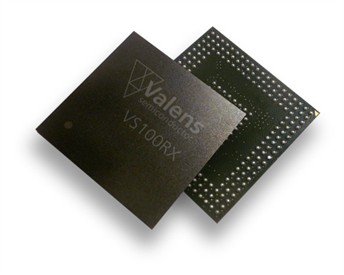
To me this sounds like an interesting chipset (although a bit out of my league) for more than one reason. One of those reasons is the printing on the chip. Why?
Well, you may not know it, but my name is Valens. Before the era of internet my family and me knew of very few other people named Valens. There was of course Richie Valens, but that is not his real name, and there were some roman emperors named Valens (I have a coin to prove it). Now that the world population is massively coming on line more and more people and companies named Valens surface.
If you are an electronics engineer and your name happens to be National, Renesas or Avago you can easily find chips with your name on it, but for most other people such an opportunity is pretty rare. And I just came across one!
I want this chipset. Not for building something with it, but to keep on my desk. I want a vanity chip(set). Of course I have contacted the company and asked for a sample. If I get hold of one of these chips I will of course post it here.
Some six months ago Texas Instruments announced the Evalbot, a development platform for their Stellaris ARM Cortex-M3 microcontrollers in the shape of a little robot. It took me a while to get hold of one, but now I have one driving happily around in my living room. It is actually a pretty neat and cleverly engineered kit that you have to assemble yourself. Most parts are made out of PCB material – the two wheels for instance are each made of three disks and a rubber ring – the rest are mainly nuts & bolts. Two little motors with gears drive the wheels and everything is powered from three AA batteries.
The Evalbot is not a gadget; it is a powerful development board with wheels. In the center off the disk-shaped board sits an LM3S9B92 ARM Cortex-M3 controller (256 KB flash, 96 KB RAM and more peripherals than you will probably ever need) assisted by a tiny 96 x 16 blue OLED display, 6 push-buttons (including the on/reset and the off buttons), an Ethernet connector, a USB host port, a USB device port, a USB debugger/programmer port (ICDI), a micro-SD card connector, a speaker, power supply, JTAG, two LEDs and probably more that I am overlooking now; and two motor drivers. Thanks to the battery holders (with batteries) on the bottom of the board the whole thing is pretty heavy and the rubber “tires” prevent sliding it off your desk when you hook the board up to a computer with a USB cable that wants to unwind the wrong way around.
A special wireless expansion port is available too on which you can plug a CC1101EM sub-1 GHz transceiver, which will get you an 868 or 915 MHz radio link. The James Bond part of this setup is a third kit from TI, the eZ430-Chronos based on the CC430F6137 sub-1 GHz RF SoC. This is a combination of a biggish but stylish black watch with a large character display and a USB access point for your PC. Once connected you can control your PC with the watch, although it takes some exercise to do it properly. But... you can also use the watch to control the Evalbot! An integrated accelerometer lets you influence the driving direction of the robot by tilting and rotating the watch. Cool huh? The watch in itself is actually a dev kit and you can reprogram it with your own application.
Programming the dev kits is done with Code Composer Studio 4, the Eclipse-based dev environment from TI. A license file is included with the Evalbot kit, but what exactly this enables is not clear to me. I did read something somewhere about code sizes & limits, but I forgot where. Anyway, all the source code for the Chronos controlled Evalbot is available, it compiles without warnings and errors and programs fine. This really is a fine (but strange) development kit.
I started life embedded in my mother and I’ve been an embedded system ever since. In this blog I will share my experiences, opinions & questions related to embedded systems & microcontrollers. Enjoy and feel free to join in.