Showing posts with label Cortex. Show all posts

Thursday, February 24, 2011

Free cup of LPCXpresso!

A bit over two weeks ago I told you how to get a free LPCXpresso board by making a short video or a photograph of how you got rid of your 8/16 bits micro-controller. I suspect/suppose that NXP will honor every participant.

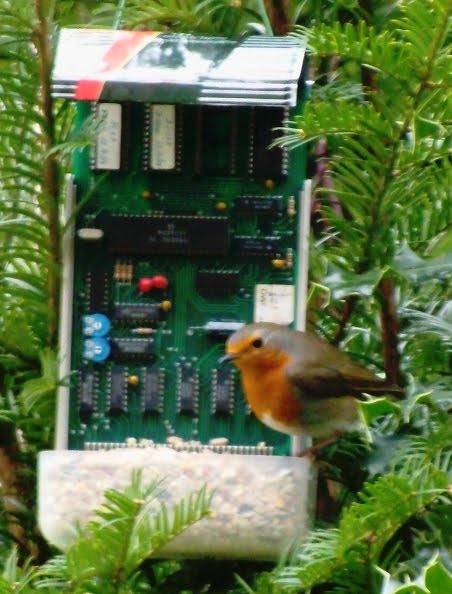
Here is a picture I received from Antoine Broussal. Note how he did the can and the peanuts.


Just to show you that it is not bogus, here is a picture of the board with its accompanying letter that I received this morning by UPS. It is, as I expected, an LPC1114 board.


Denis Xavier wrote me to tell me that his contribution was accepted too, so Denis, you want to share a cup of LPCXpresso code?

The campaign is still running and the submission stream seems to have slowed down a bit, so go give it a shot yourself!

Embedded World 2011 update: NXP ran out of stock. Please be patient.

BTW, while I was writing this, I received a press release from NXP announcing the LPC1200 series. Compared to the other LPC Cortex-M0 devices these new Cortex-M0 controllers offer up to 128 KB of flash memory, DMA, a real-time clock (RTC) and a CRC engine.

Monday, February 7, 2011

Break the 8/16-bit habit

Most people, including me, like to get stuff for free. Electronic component manufacturers know this and often they offer free samples in the hope that their parts get designed in. Microcontroller manufacturers have started doing design contests and other campaigns to get new users for their products. One of the latests campaigns was launched by NXP for their ARM Cortex-M0 parts.

NXP already did do a design contest (or challenge as they called it) for their LPC1100 parts and now they are giving away LPCXpresso boards that contain a Cortex device. To get one, all you have to do is to show how you plan to stop using 8 and 16-bit devices. You can do this by sending in a picture or a video and if accepted it will be posted here.

Here is the video I sent in.


NXP's website does not mention which LPCXpresso board you will get, but I suppose it will be the board with the LPC1114.

Here are some photos & videos I received in response to this article. Feel free to share your way of breaking the 8/16 bit habit by sending me your photo and/or video and I will put them up here too.


L. Francey prefers to use his obsolete microcontrollers to create arty objects.


Marc will eat anything that has legs.


Jonathan likes Aciiid!


Denis combines his passions for nature and electronics.

Thursday, March 11, 2010

It's a tactile green embedded world

Last week I visited Embedded World 2010 in Nuremberg in Germany. Nuremberg is a nice city with a mediaeval city center and even though I had a hotel room right on the main market place, I did not see much of the town because of the show. The show was pretty big, more than 700 exhibitors spread out over three halls and allthough I spent two full days there, I did not have enough time to see everything.

The main theme of the show was green electronics. Lots of companies showed off green products, low-power boards and microcontrollers. Although low power electronics is very important, there were not many real green novelties. Microamps per megahertz is the most common term now and several manufacturers claim that their products have the lowest number. Unfortunately these numbers are difficult to compare, because one manufacturer talks about a 32-bit controller whereas another is talking about an 8-bit controller. Actually uA/Mhz is not a good measure, it would be better to use something like uA/MIPS or so. Energy Micro, a company that I didn't know before, won the Embedded World award in the category Hardware. Their EFM32 32-bit MCU (ARM Cortex-M3) consumes 180 uA/MHz (running at 32 MHz and 3V).

Another big thing these days is touch technology. In the coming years everything will be tactile, if we can believe the Embedded World exhibitors. Personally I am a bit weary of touch interfaces. At the end of the seventies touch keys were hot too. Being a poor student I had recovered a third-hand color TV with touch keys for the channel selection. These keys were very sensible to weather conditions and my TV changed station randomly, especially when humidity was high or when I really wanted to see something. One day this TV caught spontaneously fire and I finally got rid of it, but that's another story.

Now I have a monitor with touch keys. I also have a cat. It has happened several times that the cat changed the settings of my monitor in a completely random way just by striking the tactile surface of the monitor. I guess I’ll just have to wait until the touch craze has passed before I buy any new kit.

Sunday, February 7, 2010

LPCXpresso design contest

Last week I received two LPCXpresso boards designed by Embedded Artists for evaluation. An LPCXpresso board is a small but longish 35 by 140 mm board split in two parts. One part has an ARM Cortex (M0 or M3) processor from NXP (LPC1114 or LPC1343) on it, together with a 12 MHz crystal and a small prototyping area. The other part of the board is the LPC-Link, which is a real JTAG programmer/debugger. This part is a sort of detachable JTAG pod and if you cut the connections between the two rows of JTAG connector pads you can connect it to other compatible hardware, your own ARM board for instance.

Why is this interesting? Well, first of all because of the price, since Embedded Artists sells it for only 20 euros. This means that you can get yourself a JTAG debugger for a very good price.

Then there are the development tools (Windows only, but should also work on virtual platforms with USB support on other operating systems). The boards are supported by a free enhanced Eclipse-based IDE developed by Code Red. This software lets you compile programs of unlimited size, but program and debug only up to 128 KB. The NXP web site has a list of compatible processors which is unfortunately missing the LPC2148, but according to NXP it should work with unlisted controllers too, as long as you respect the 128 KB limit. I have yet see this as the IDE does not allow picking an incompatible controller and an LPC2142 is not an LPC2148.


LPCXpresso LPC1114 together with an mbed module and the mbed pin-out card. Everything on the left of the pin-out card is the LPC-link JTAG pod.

Note that the LPCXpresso is pin compatible with an mbed board. That may seem strange as an mbed module only has 40 pins whereas an LPCXpresso has 54, but pin 1 to 20 and pin 28 to 47 of the LPCXpresso module have (where possible) the same functionality as the mbed pins. One problem though, the mbed processors (LPC1768 and LPC2368) are not supported by the LPCXpresso IDE. I have been told though that a Cortex-M0 mbed is coming soon.

Also interesting is that NXP has launched a design contest. Anyone entering a valid design concept before the 8th of March 2010 will receive a free LPCXpresso development kit and then has about one month to actually build it and show that it works. Check out all the details here.